
The soul of a company
Why a company is a living organization, not a machine. How a company can carry tension and even trauma, and what changes when leaders learn to perceive the layer beneath strategy and structure.
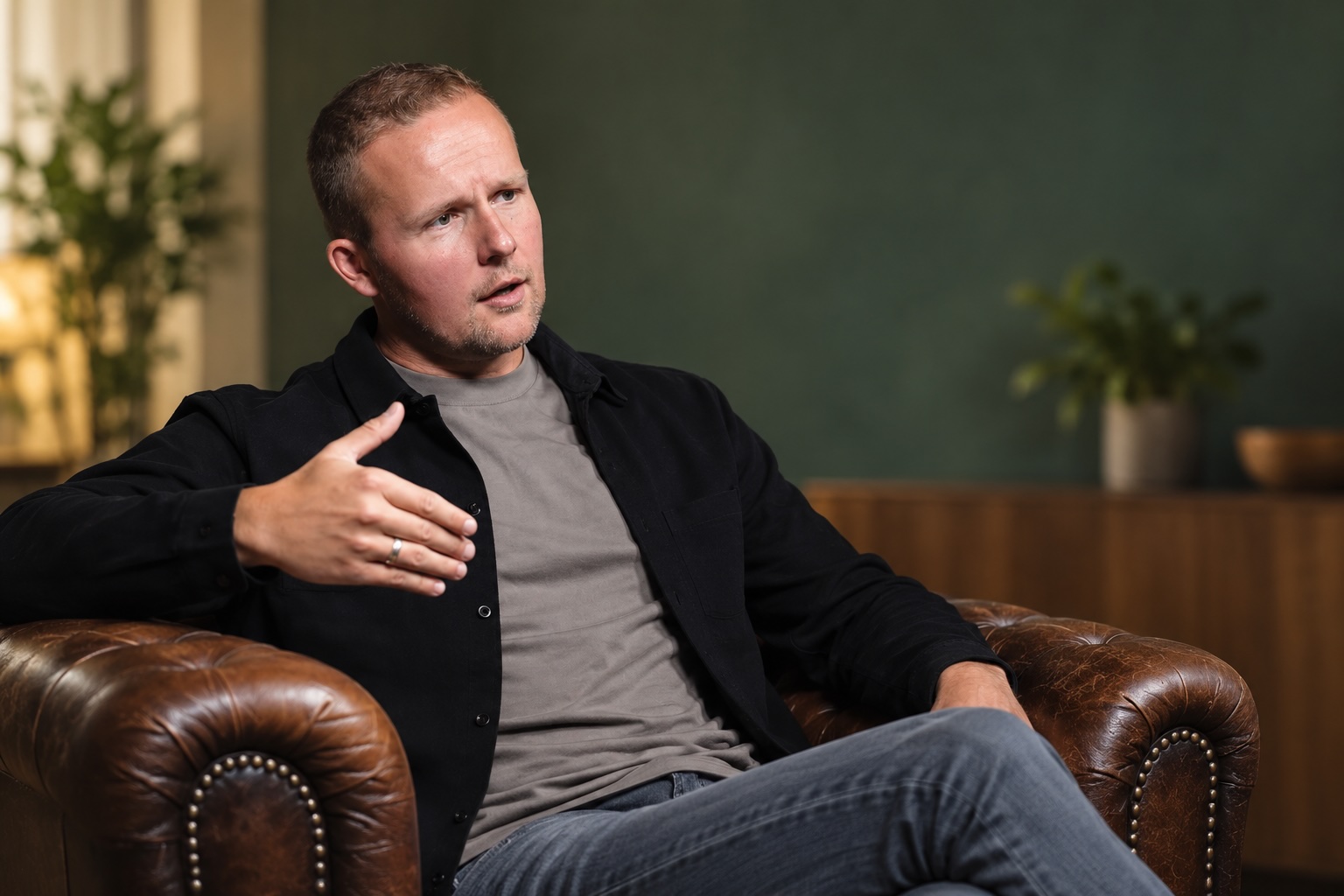
“A company has a body. It grows, loses balance, carries tension and sometimes trauma, just like a person.”
Three layers of a company
Most consultancy works on the first layer, some on the second. Lasting change usually starts in the third.
What everyone sees
Strategy, structure, figures, products. The part of the company that ends up in the annual report.
Culture and patterns
Rituals, habits, unwritten rules, the way decisions really get made. The territory of corporate anthropology.
The field
Where energy flows and where it gets stuck. Where tension is held, what the history still carries, and what the next phase is asking for.
The living company, explained
What we mean by a living organization
Most management thinking treats a company as a machine: inputs, processes, outputs. That works, up to a point. Every leader also knows the other side: the team that loses its spark after a reorganization, the culture that quietly resists every change, the company that seems to repeat its founder’s story.
We look at a company the way a psychologist looks at a person. It has a body, a history and a character. It grows through phases, gets stuck, compensates and sometimes heals. With energy we do not mean anything vague: it is the tangible reality of where things flow, where they stall and where growth is possible.
When the living company is hurt
A living company can also be hurt. A founder who left in anger, a merger that was never digested, a crisis that everyone survived and nobody talked about. The figures recover, but the organization keeps reacting as if the danger is still there. What is not worked through, repeats.
We wrote about this at length in organizational trauma: why your company is a patient too, a summary of Dirk Jan’s book. Here we focus on the other side: the consciousness and the soul of a company, and of the people who lead it.
Building on Wilber and Laloux
Ken Wilber’s integral theory gave leaders a map of how consciousness develops, in people and in cultures. Frederic Laloux’s Reinventing Organizations showed what organizations can become when they are run from a later stage of that development, and called them living systems.
Both are, in a sense, descriptions from above: what a conscious organization looks like. In our daily work we meet the other side. The founder whose old wound became the company’s blind spot. The self-managing team that falls apart because nobody can bear conflict. The purpose statement that everyone believes in and nobody feels. That is where the inner work begins, for the leader and for the company.
Consciousness, soul and leadership
Many of the leaders we work with are on an inner path, whether they call it that or not. Some come from a religious background they have outgrown. Others are highly sensitive or gifted, and perceive more in people and organizations than they can explain. That perception is often their edge, and sometimes their burden.
Soul-centered psychology takes that inner dimension seriously, without losing touch with the business. We draw on transpersonal and integral psychology, esoteric psychology, contemplative traditions including Christian mysticism, and body-oriented methods such as brainspotting. Not as beliefs to adopt, but as ways of seeing what is happening beneath the surface.
How we work
With the ECA Leadership Framework (Energetic Corporate Anthropology) we map what is at play beneath the visible structure of a company. We look at:
- where tension is being held;
- where growth stalls;
- where energy flows, or quietly drains away;
- where decisions do not land;
- where leadership is not fully taken;
- where old patterns block the next phase;
- where purpose, culture and presence no longer line up.
For the leader, we combine psychological and body-oriented work with the language of business. Because in a company, the personal and the organizational are never separate: who the leader is, shows in the company.
Where this perspective comes from
Dirk Jan Versluis is a psychologist (NIP) and co-founder of Triunify with Anne-Marie Versluis. Alongside his clinical work with entrepreneurs and leaders, he has spent more than ten years studying and practicing the psychology of consciousness: integral psychology, esoteric psychology and healing, energetic anthropology, advanced forms of meditation, body-oriented work and brainspotting, and the contemplative side of the Christian tradition he grew up in.
He teaches, develops new methods and gives lectures in this field, and has worked for years with highly sensitive and gifted people. The ECA Leadership Framework grew out of the meeting of these two worlds: the consulting room and the boardroom.
Also by Dirk Jan Versluis
Frequently asked questions
What is a living company?
A way of looking at an organization not only as an economic or legal structure, but as a living whole with its own body, history, tension, culture and direction of growth. Like a person, a company can thrive, lose balance, carry old wounds and grow into a next phase.
Is this spiritual, or is it business?
Both, and we keep them in their place. Our work is grounded in psychology and in the reality of running a company. The deeper layer, call it consciousness or soul, is something you can learn to perceive and work with. It is not a belief you need to adopt.
How does this relate to Teal and Reinventing Organizations?
Frederic Laloux described what organizations can look like when they are run as living systems, and Ken Wilber gave us the map of developmental stages behind it. We build on both. Our focus is the clinical side: what stops a company from living, how you perceive that, and how you work with it.
What is organizational trauma?
Shocks a company never digested: a founder who left abruptly, a reorganization, a merger, a betrayal between partners. They keep shaping the culture long after the event, in mistrust, avoidance or repeated conflict. Just like a person, a company can carry its history in its body.
Who is this for?
For founders, leaders and boards who sense that something in their organization is not visible on any dashboard, and for leaders on a personal path of inner development who want that path to make a difference in their work.
Sense there is more going on in your company?
In a free 45-minute strategy session we explore what is at play and whether we are a good fit. Confidential, under the professional code of the Dutch Association of Psychologists (NIP).
Book a strategy session →